
WELL, I’VE NEVER BEEN TO SPAIN*
*CW: violence, discrimination, sexual assault
Nor have I been to Oklahoma…
I am doubtful many will know the Three Dog Night song I am referencing, but it’s been rattling around my braincage since I landed in Madrid a few weeks ago. In fact, I have been to Spain; I found myself unexpectedly moving there last month. Perhaps you are aware, but there is a housing crisis in Amsterdam (and Netherlands in general), and yours truly was sans sub-lease last-minute. Yet another expat foolishly wishing to settle down in one of Europe’s most expensive cities. Please, throw your tomatoes.
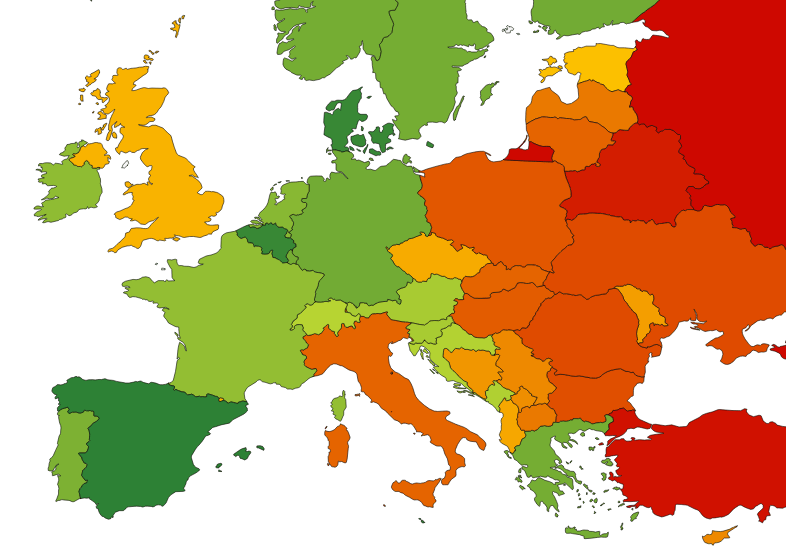
A series of delays due to the Strait of Hormuz, which made it quite difficult to leave South Africa, and an old friend from the States led me to suddenly change course from Netherlands to Spain. This just so happened to coincide with the ILGA’s 2026 report on LGBTQ+ rights across Europe, and Spain is topping. As a political scientist and queer immigrant to Spain, I will be analyzing the new rankings, specifically focusing on the changing state of trans rights across Europe.
SPAIN TOPS MALTA
Numerous other publications have reported on the new rankings, primarily focusing on Malta’s dethroning as Europe’s #1 LGBTQ+ friendly country for a decade. Scores are calculated based on 7 different categories of legal protections, predominantly concerned with non-discrimination policy and protections against hate crimes and hate speech. The top 5 countries have remained the same as last year, though Spain has risen from 5th place to 1st scoring 88.7%, and Malta now sits in 2nd just one percentage point below at 87.73%. Iceland has remained in 3rd place, followed by Belgium down from 2nd place to 4th, and Denmark down from 4th to 5th.
The reshuffling of the top 5 comes from a place of simultaneous widespread democratic backsliding and policy stagnation, especially in Malta where proposed anti-discrimination frameworks have remained tabled since 2019. In contrast, Spain’s rise to the top is a result of significant efforts on the Spanish government’s part to improve legal protections following commitments made in 2023. ILGA-Europe’s deputy director, Katrin Hugendubel, praised Spain’s achievements for trans individuals, specifically highlighting national efforts to combat far-right anti-trans sentiments, a new non-discrimination authority, and depathologization of trans identities in healthcare.
While Spain has certainly made commendable legal progress, there still exists a gap between policy and practice. The Estado LGTBI+ 2026 report notes that 54% of queer subjects residing in Spain experienced some kind of violence or hate crime in the last year. This is an increase compared to previous years, and while a significant portion of Spain’s residents identify in some way as queer, especially among younger generations, there continues to be a worrying trend of increased assaults and harassment. The last few years have seen extremely progressive legal protections introduced in Spain, including the 2024 Strategy for Equal Treatment and Non-Descrimination, and the 2025 Strategy for the Social Inclusion of Trans People. However, over 2/3rds of LGTBI+ individuals polled by the state reported that, despite the new legal frameworks, hate crimes and violence have either remained the same as pre-legislation or even increased.
In summary, while the ILGA report certainly has merit, to claim Spain is suddenly Europe’s most queer-friendly country based on legal protections alone is inaccurate, and the Spanish state is well aware of the unfortunate distance between legal frameworks and civil experiences. Spain scored 100% in the ILGA categories of Family, Civil Society, and Asylum, with Equality and Non-Descrimination at 98%. While Spain has the highest combined score across all seven categories overall, the country with most trans-specific protections is Iceland.
TRANS-SPECIFIC POLICY ANALYSIS
Iceland specifically has hate crime and hate speech laws protecting trans identities and sex characteristics, as well as a 100% score in the Legal Gender Recognition category. The only other country in the top 5 also scoring 100% in this category is Malta. Spain, Belgium, and Denmark all lack recognition for non-binary identities and have age restrictions on transition and/or name and gender changes. Iceland, Malta, and Spain are the only three countries prohibiting medical intervention of intersex individuals without informed consent. Unfortunately, this still only meets 1 out of 4 criteria in the Intersex category.
The 2026 Trans Rights Index & Map (TGEU) also supports the notion that, while legal protections have changed on paper, no sustained or meaningful political progress has been made across Europe and Central Asia. Most of the legislation has come from activists and court rulings rather than the state itself, which has often remained reluctant or apathetic to address the increase in violence towards trans individuals. This increase is happening at an alarming rate on a global scale in tandem with democratic backsliding
Similar to broad queer protections in Spain, the experience of trans individuals shows that even progressive legislation, when passed, increasingly does not adequately improve quality of life for said individuals. This year’s map documented “targeted and deliberate regressions” in policy which consistently utilized constitutional amendments to restrict, repeal, and criminalize the rights and existence of trans individuals.
Eastern Europe and Central Asia have been particularly volatile as of late, which TGEU links to Russian influence, particularly in Slovakia and Belarus, as well as Hungary up until quite recently. Additionally, it is impossible to discuss declining trans rights in Europe without mentioning the UK. Once the top of ILGA’s map, the UK, with all of its recent regressive laws, sits relatively in the middle, ranked 22 out of 49 countries, marking no change from last year.
IT’S NOT *ALL* BAD
Dearest reader, let us take a moment to breathe, for I promise despite the bad news, we will also acknowledge several landmark rulings thanks to activists and the EU Court of Justice (CJEU).
Sidenote, while Slovakia might not be particularly trans friendly, may I say that my favorite art museum in recent memory was the Slovak National Gallery in Bratislava, and I cannot recommend the works of Slovakian artist Dušan Králik enough. The SNG also happens to be around the corner from Cat Cafe MON AMI, which houses cats from Ukraine.
Alright, back to the news. I promised positive updates, so allow me to summarize four key recent rulings by the CJEU:
- Individuals must be able to easily correct gendered data
- Official documents must reflect lived gender identity
- Sterilisation cannot be required for gender marker changes, and
- EU values and sex discrimination laws include trans people with no exceptions
To summarize so far; this year has seen an alarming amount of legislation and constitutional amendments targeting and reversing trans rights across the European continent. However, we have also seen significant efforts in multiple governments to increase protections for all queer people, particularly in Spain. These wins for rights, specifically in the trans community, are too often coming from trans activists and individuals themselves rather than the state.
Additionally, there exists a gap between written legislation and enforcement of it, with queer and trans experiences often remaining static or worsening despite new protections. It is for this reason and more that a measurement of queer and trans acceptance based on legislation alone is inadequate.
What we are considering a “win” for queer and trans rights are at best bare minimum, and a direct result of the current global political climate which is increasingly volatile towards us. Dearest reader, we are fighting a Sisyphean and uphill battle. Despite the horrors, I remain silly. There is hope, and trans joy will persist.
MY OWN THOUGHTS ON SPAIN
First; it is really goddamn hot. Second; I am proudly and extremely visibly trans, and despite my terrible Spanish, neon green hair, excess of tattoos and piercings, and all the things that make people stare; everyone has been quite lovely.
There are some teen boys that frequently try to get a look at my legs every time I visit the Supermercado, but even they are harmless compared to violence and ostracization I’ve experienced elsewhere. That is to say, nowhere is perfect, but I have so far found Spain to be pretty chill.
Perhaps this joke is a bit too dark, but again, I remain silly; I didn’t even get sexually assaulted by airport security in Madrid! It’s okay, you can laugh at that. I am giving you explicit permission *imagine a thumbs up emoji here*.
My aforementioned friend from the states, who so graciously allowed me into their home just days before my arrival, has lived here for over a year now. As a gender nonconforming black person, they left the US in response to Trump 2.0, having experienced direct racial and queer violence under Trump 1.0. Spain for them has been a safe haven, but not necessarily a loudly queer paradise; and yet, leagues better than the States. I myself left years ago, and it frightens me the amount of anti-trans legislation and violence of Trump 2.0, as well as it’s effects on global politics.
I won’t end on a negative note, dear reader, so let us celebrate some other trans achievements despite it all.
Czechia no longer requires surgery and sterilisation, Austria has introduced legal non-binary gender markers, and Albania has introduced new protections for gender expression and identity in anticipation of joining the EU. Lastly, Poland no longer requires trans people to sue their parents in order to legally change their gender; that one was crazy to learn, lots of love for my Polish trans siblings.
To conclude; things may be bleak from a legal and political perspective, but we have each other, and it is through hope, joy, and community that we will reshape this world.
This is Mia Mature, signing off.
Euphamia Mature (they/she) is a girlboy from Newark, New Jersey. They have a bachelor’s in Political Science from Miami University and are in the final semester of an international master’s in Diplomacy at the School for International Training. When she is not reading, researching, country-hopping, or writing, she enjoys playing Digimon, collecting tattoos, and dancing to noise music in abandoned warehouses. You can find their poetry performances on YouTube @n30nf41ry.