
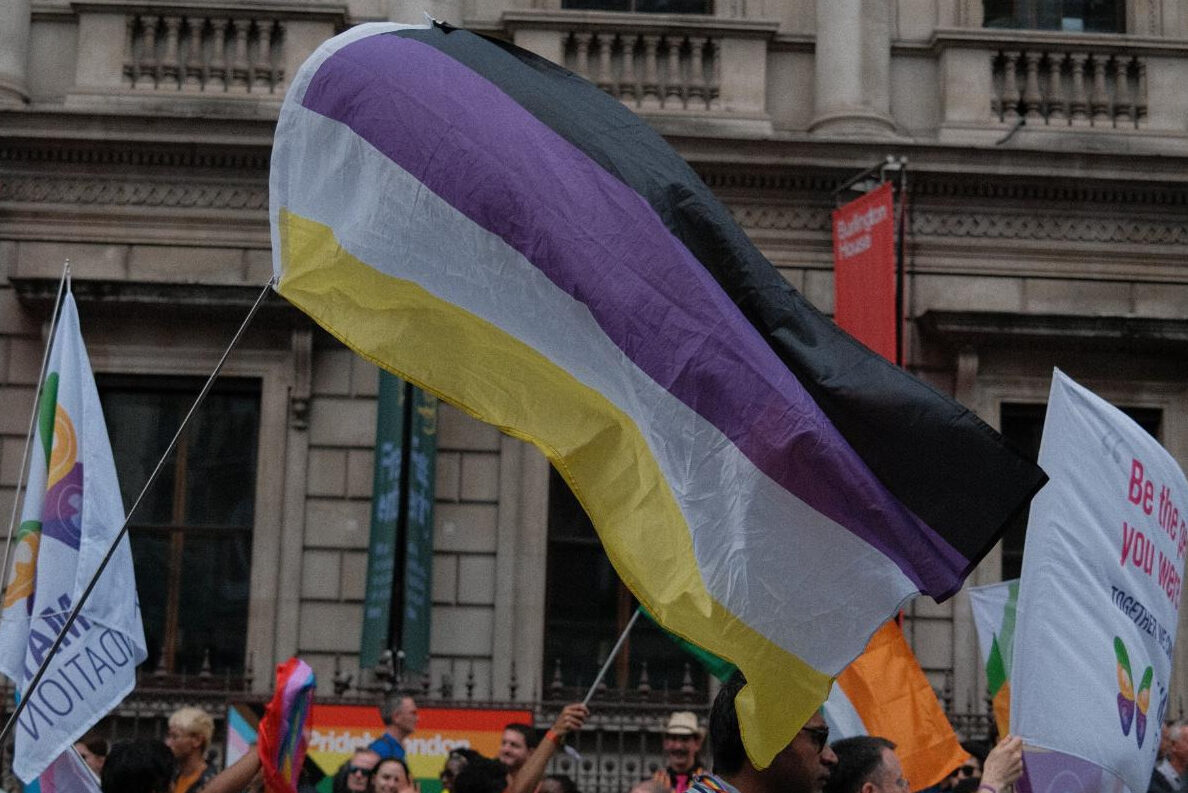
ILLEGALLY NONBINARY
Euphamia Mature
In my previous article, I highlighted and criticised ILGA Europe’s 2026 report on changing queer rights across 49 European countries. The scale by which this report and others like it measure a country’s queer rating is primarily concerned with government policies and does not account for cultural acceptance or lived experiences of queer people affected by such laws.
One of the ILGA’s categories specifically analyzes trans rights, considering things like quality of and access to gender-affirming healthcare, constitutional protections against discrimination, and ease of name and gender changes on legal documentation. As more governments continue to center trans people in politics, conversations about “legal gender”, state recognition of trans people, and their rights to self-determination have spread globally. In the last two years alone, a multitude of countries have ruled to allow for a third “X” gender option for nonbinary and/or intersex individuals on a federal level. This article analyzes international policy changes regarding self-determination and rights for gender diverse individuals amid the growing global trend of the gender binary’s devolvement into a tertiary defined and dictated by the state.
HIGHLIGHTS FROM THE LAST TWO YEARS
Germany’s Gender Self-Determination Act passed in 2024, replacing outdated legislation from the 80s which required trans people to obtain two reports from psychologists and petition a court to self-identify. Today, anybody can change their name or gender once a year without explanation, including minors ages 14 and up with guardian consent, and the family court can still rule in favor of the child if the guardian does not consent. Additionally, outing or deadnaming somebody can be fined up to €10,000, and individuals subject to the previous process may apply for financial compensation. Genderqueer Germans have the option to identify as “diverse” instead of “male” or “female”, or may choose to have their gender deleted from documentation.
Australia was one of the first countries to allow “X” gender options on passports back in 2011, though it was only available to intersex individuals. This option was extended to nonbinary people beginning with the Australian Capital Territory in 2016 and gradually adopted by other states. New South Wales was the final state to grant recognition in 2025, thus making “X” gender universally recognized across Australia.
Belgium, which placed 4th in the 2026 ILGA ranking, has not made “X” an option, opting instead to allow anyone to remove their gender from their ID card as of 2025. The Constitutional Court ruled in 2019 that binary gender markers discriminated against nonbinary people, prompting legal action from the federal government. While individuals may change their legal gender marker, the only options remain “male” and “female” and birth certificates are still subject to the state’s definition of “biological gender”, meaning that even if a Belgian resident removes their gender from their ID, their state-assigned gender remains in the database.
Austria changed to a system of self-identification in late 2025 after the Constitutional Court ruled in 2018 that exclusive binary gender options violated constitutional equality according to the European Convention on Human Rights. Prior to this ruling, gender diverse markers were only available to intersex individuals and medical intervention and diagnosed gender identity disorders were a prerequisite. The new ruling drops medical and psychological requirements and decouples nonbinary and intersex identities, declaring compulsory binary registration to be a violation of nonbinary human rights. Austrians can now identify as “inter” for intersex, “divers” (same concept as Germany) “offen” (directly translated as “open”) or opt out of a gender marker entirely.
And of course, the wretched and hypocritical “Land of the Free” allowed “X” gender passports for a meager three years under the Biden administration, beginning 11 April, 2022 only to be obliterated by 22 January, 2025 following the Fascist’s re-election. Just hours after entering office on 20 January 2025, Dingo Tramp passed the executive order titled “DEFENDING WOMEN FROM GENDER IDEOLOGY EXTREMISM AND RESTORING BIOLOGICAL TRUTH TO THE FEDERAL GOVERNMENT” (Executive Order 14168) which reinstated a harsh “biological” gender binary through a multitude of regressive policies targeting trans people. U.S. District Judge Julia Kobick fought against the executive order in June of 2025 but ultimately lost when the Supreme Court ruled in favor of Trump, reinstating 14168 on 6 November that same year. State IDs remain under the jurisdiction of individual states, and roughly half of the country (and Puerto Rico as of 2025!) allow “X” gender on other forms of ID. Oregon was the first state to adopt “X” as an option in 2017, and I am one of those individuals with a nonbinary Oregon state ID.
EUPHAMIA’S GENDER JOURNEY
If you might kindly indulge my vanity, I’d like to offer a personal reflection about the reductive and faux-progressive nature of “X” gender rulings in the context of my own gender.
In 2018, I had the privilege to witness and learn from activist, comedian, and poet Alok Vaid Mennon. They performed pieces from Femme in Public and taught a workshop which expedited my development both as a writer and a trans person. It was Alok who first taught me what it meant to be a “girlboy”. Before them, I was an unsatisfied high-femme nonbinary person who read as a confusing gay boy. Even prior to estrogen my gender presentation perplexed people. Working as a server at 17 while sporting a harsh dykey undercut with purple highlights (it was 2018, be kind to me) I was consistently mistaken for a woman in my 30s, which felt simultaneously strange yet somewhat validating. Despite the confusion, long stares and not-so-subtle whispers from strangers behind my back, my understanding and public perception of my gender continued to disappoint.
I started identifying as nonbinary at age 15 after years of difficulty deconstructing my violent aversion to masculine labels and socialization. I hated being called a boy, I hated doing “boy things”, and I was extremely uncomfortable around any group of men. I was lucky to know several transmascs my age and their relationships with masculinity assisted me in understanding my own dysphoria. I look back at my earlier poetry where I essentially say in a million different ways “I want to be a girl”. I was terrified and lacked the vocabulary and therapy to dissect these feelings, and everybody around me seemed to insist that I was just a very feminine gayboy. I was most certainly Not A Boy, but I was also not a Girl, and definitely neither a woman nor a man.
This was in 2015, and YouTube, tumblr, and my all-queer high-school friend group collectively introduced me to “nonbinary”, and teenage Euphamia, desperate for solidarity and vocabulary, quickly adopted the identity. Steven Universe was still airing (I have a lot to say about Pearl’s impact on my understanding of femininity, but that is for another essay), I was doing makeup in the front camera of my phone while sat behind the library checkout desk only to wipe it off before I went home so my mom wouldn’t see, and everybody else wanted to find the Right Word (oftentimes a slur) to call me.
My identity was never my own and it seemed I owed everyone an explanation for what I was doing with my gender despite not knowing myself. My femininity was unwelcome, my body, voice, clothes and gait were scrutinized, and I dreamed of a girl (lowercase g, not capital) trapped in the corpse of a teenage boy, desperate for someone to recognize her existence.
When I was 15, “nonbinary” worked well enough, but I continued to long for more overt and outward feminine expression and understanding which I both muted and ignored. Everything continued to feel violently wrong.
Girlboy. Alok Vaid Mennon got up on stage at Miami University and introduced themself as a girlboy. They were unabashedly genderfuck, made jokes about body hair poking out of dresses, and how their performance and understanding of femininity was not defined by the parameters of thin, cis white women. This was it, the lightbulb moment. It was three more years before I said “Euphamia” out loud to another trans girl while crossfaded one night in Luxembourg, and another year after that before I would let myself use ‘she’ because it no longer felt like I was alluding to a binary expectation of womanhood, like I was some parody of a girl.
This strong aversion to and fear of binary womanhood prevented me from pursuing estrogen for many years. After immersing myself in a primarily transfeminine social circle, I began to socially transition yet still felt something was missing. I befriended dozens of girls in various stages of transition, euphoric about breast growth, sporting empty vials of estrogen as earrings and crowdsourcing hormones for those in need. These girls were so astoundingly alive in a way that made me ache. I felt a hunger for something, and these girls were inspiring but they did not look how I imagined “Euphamia”. I continued to glare at a stranger in the mirror, a rotting corpse hosting a listless girlboy made to feel like a parasite.
It was not until I moved to Portland, Oregon in 2022 that I sought nonbinary medical transition. My very first estrogen shot happened in February of 2023 in the bathroom of my slanted apartment on Holgate, 2ml of estradiol in the syringe and 20mg of Tamoxifen to stunt my breast growth washed down with a yerba maté from Plaid Pantry. After years of running away, I surrendered.
MY GENDER CONTAINS MULTITUDES
My gender is the dream of a 6 year old girl who was ridiculed for wanting Littlest Petshop toys and Hello Kitty stationary. My gender is the first pair of heels I bought at 14 with my first paycheck from Famous Footwear and hid in the back of my closet. My gender is the needle with which I choose to bleed on my own terms. At 16 I felt in control for the very first time when the piercer’s gentle hand pushed through flesh on the exhale, felt like a girl for the very first time when 6 months later I wore dangly earrings. My gender is the scars full of ink that decorate my body, vivid and vibrant hues of art and expression which transform skin to canvas. My gender is the way my hands sit on my hips now in a manner that resembles Gabriella from High School Musical. My gender is the neon green hair dye that stains my pillowcases, hoodies, and headphones. My gender contains multitudes, and the state does not need to document or categorize it.
“LEGALLY” NONBINARY
Thanks for indulging my gender journey anecdote there, but let’s resume the political analysis and how this relates. Does my gender, as I have briefly summarized to you, invoke “nonbinary” according to its evolving legal definition? Linguistically, “nonbinary” is literally just “not binary”, yet its intended purpose of escaping the gender binary is stunted by existing in reference to it. Rather than defining itself by what it is, nonbinary is defined by what it is not. The identity is dependent upon the binary. This leaves a void of interpretation which is being further restricted by governments that wish to constrain and define it.
The state has increasingly co-opted “nonbinary” as an all-encompassing third gender which often includes intersex individuals. Policies regarding trans rights and the right to self-determination inform each other globally, and there has been a trend both socially and politically of neutering and assimilating the concept into existing binary gender culture. No longer is there a gender binary, but now a tertiary of sorts, with “nonbinary” as this sort of sexy, confusing and mysteriously androgynous third gender. Culturally, nonbinary’s connotation and expectations associated with it have centered androgyny as a requirement, and transfeminine people, especially POC, have frequently faced more scrutiny over their gender presentation.
The state and society’s need to label its sexual subjects, to ascribe them categorical terminology by which to dictate their rights and social order, and the devolvement of “nonbinary” from an alternative to an expansion of the binary has strangled and recontextualized the identity within oppressive and cis-heteropatriarchal structures. The widening of the gender binary into a tertiary is not the solution to trans persecution. It perpetuates a limited understanding of gender. There are not three genders, as more governments have come to determine. There are, in my humble opinion, as many genders as there are people in the world. The path to expanded and inclusive self-determination is not more gender options on legal documentation, but rather the abolishment of such a requirement.
Let me clarify that there is absolutely nothing wrong with identifying as nonbinary, or any other gender for that matter, be they “state recognized” or not. The issue is how its meaning has been reduced by governments who wish to categorize us while calling it progress. The addition of “X” gender on documentation lumps all gender diverse people into an “other” category; there is now male, female, and “everything else”, and in many countries this includes or is exclusively reserved for intersex individuals. I find this reductive of all intersex, trans and gender-nonconforming individuals, whether they identify as nonbinary or not. We are not all the same gender of “other”, and to celebrate additional state-madated gender options as progress, to measure trans rights by whether or not individuals can “legally” declare themselves as “other” depoliticizes the trans community’s fight for equal rights by forcibly assimilating nonbinary and intersex people into the accepted binary gender status quo. Trans liberation should be about resistance to and dismantling of the cis-heteropatriarchy, not aspiring for “acceptance” within its oppressive structures. Adoption of “X” gender options has become the new method of political distraction from genuine progress, much like how marriage equality before it dominated conversations about queer rights.
Many governments have increasingly masked growing transphobia behind seemingly progressive access to gender affirming healthcare which they often require. On the European continent alone, 30 out of 49 countries mandate HRT and sterilization to legally change one’s name and/or gender, and 19 require surgical intervention. Consider this; is the addition of nonbinary markers a win for trans people, or does its foundation upon a suffocating system which dictates what “correct” gender performance looks like set a dangerous precedent for forced medical transition to conform to an acceptable definition of “nonbinary” according to legislation?
My nonbinary transition was my choice alone and the byproduct of progressive legislation in Oregon that allowed me to experiment. I did not need to be on HRT to self-identify as trans, but this is not the case for countless others.
Imagine the nonbinary stereotype the internet has jointly constructed; Sock, they/them, living in Portland with three partners, working as a barista below minimum wage at an independent coffee shop, and wearing a septum ring. This is a silly meme, yes, but consider the implications of the gender binary’s conditional acceptance of “nonbinary” as a valid and recognized gender. There exists an expectation to “look ‘nonbinary’” as defined by the state and society’s standards alike. Just as binary trans people are often pressured and/or aim to ‘pass’ as their gender according to cis understandings, nonbinary people are being forced to ‘pass’ as Nonbinary, Capital N, officially and legally recognized.
Modern understandings and definitions of both sex and gender have been impacted by Western colonialism, which has perpetually used the gender binary to categorize, colonize, and control individuals. I think of Alok and their inspiring rejection and criticisms of the Western gender binary. I think of the skinny white trans girls I have met who shave their legs and tuck, the centering of dysphoria and medical transition as prerequisites for being trans, and I think of me and Alok, brown skin and body hair, eyeliner and lipstick and not color-correcting our stubble, seeking to dismantle the binary rather than join it.
Alok has emphasized in a multitude of interviews the difference between respect and understanding, in that one does not need to understand somebody’s gender identity in order to respect it. I see the state’s adoption of “X” as a feeble, neo-colonial way to try and “understand” genderqueer people through a binary gender lens. Even other queer and trans people are guilty of categorizing nonbinary individuals as either “girl nonbinary” or “boy nonbinary”. How quickly we forget the regressive impact “AMAB” and “AFAB” had on genderqueer identities and terminology.
When I consider my own gender and the events which led me to choose “X” when offered, I feel I’ve dishonored the girl I set free by asking her to exist within somebody else’s parameters. I now see my gender marker as a sort of modern approximation of the Nazi pink triangle. My name is on a list, I am “legally” nonbinary, and the government knows I am trans.
To be continued…
If this article sparked something in you and you want to share, please send your thoughts my way by emailing fae.mature@proton.me. Additionally, my master’s research is live and I would be so super appreciative if you would take my survey (available in 8, soon to be 11 languages) and share it with every queer person you know! Several questions consider legal gender markers, and widespread, global opinions are crucial to my thesis!
FAE / FAIRY / EUPHIE / MIA / EUPHAMIA MATURE is a Jersey girlboy living in Spain and wondering where the hell to go when her visa expires in August. They spend a majority of their time staring at their laptop, phone, or e-reader, and recently got new glasses to help! Her 26th birthday is on June 27th, so if you’d like to wish them a happy birthday and tell them how pretty they are, follow her on Instagram @30__41 and maybe check out their slam poetry on YouTube.