
Empathy Pending…
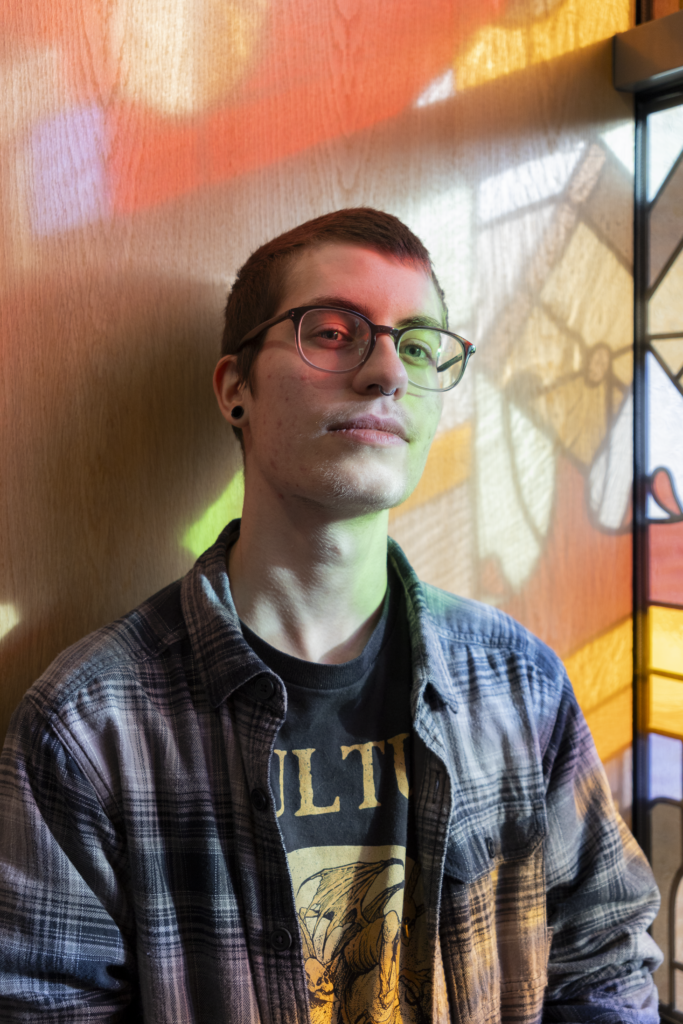
Photo interview Lane Hop, by Nick van Extel
‘What do YOU think is too long for life-saving care?’
My name is Nick van Extel, they/them. I am a trans-masc & non-binary person and I’m currently studying Photography, Film & The Digital at St. Joost, in Breda. The photography projects I mainly create have a social theme, with the most common one being ‘capturing trans people and their experiences’.
“Empathy Pending” is therefore also a photographic documentary project, which I started out of a desire for empathy for the lives and concerns of trans people. For this project, I talked to trans people of different origins and lifestyles. For example, I gained several insights into their experiences with gender care and their thoughts on trans rights.
Transgendernetwerk research on the Mediamonitor of 2024, in 2025, shows that the way trans and non-binary people are portrayed in the media is deteriorating exponentially. It is also made it clear that trans people are more often the subject instead of part of the conversation. I find this very worrying to read, but also to experience for myself. Both online and on the street.
This also came up during each of the interviews I’ve held for this project. For example, several have experienced verbal and/or physical violence. Only because they want to go through life as their authentic self.
“Be yourself and say ‘fuck you’ to the people who don’t think that’s ‘okay’.”
– Lane Hop
“Okay, I really have to do something now that will make me feel good
again.”
During my interview with Lane Hop (he/him or they/them) a clear theme emerged. It showed that both understanding and good care play a leading role in the lives of trans people. My hope is that everyone who reads this article will learn something about how they can have more empathy for others and especially for trans people. Below I have listed some of the questions I asked during the interview, along with important tips that Lane has for readers.
The interview
What was the reaction from family and friends when you transitioned?
“I’ve been queer for a very long time. I knew that from primary school. But being trans was quite new to me and difficult to tell others. Everyone understood and were also very happy for me. No one else has had a problem with that, except my mother still. Though this has improved after a year and a half.”
“My mother mainly finds the pronouns difficult and also a bit about me being trans. For parents, it is mainly a grieving process. The loss of one child, but you get a nicer and happier child in return. So it’s also surrendering and adapting to the new situation. Some need a little longer than others, but I give her all the time she needs.”
“As advice to practice with the pronouns, I recommend the book ‘FAQ Gender’ by Mandy Woelkens and Thorn de Vries.”
“I have learned to give myself time, to take time and allow myself to take up space.
You have to go off of how you feel in your transition and rely very much on your gut feeling.”
What have you noticed so far within the transgender healthcare system?
“At most during the entire process, I had to wait 2 years. I had signed in to two gender clinics, BuroJIJ and OOG Psychologen. I said to OOG Psychologen ‘hey, I can’t do it and I can’t oversee it anymore. I really want to start my medical transition’, because the gender dysphoria was so bad at the time. OOG Psychologen had said ‘okay, you already have the diagnosis, so I can refer you to the Gender Clinic in Bosch en Duin’, where I am still now. A month after reporting this, I had my first appointment there.”
“I have also been in S-GGZ for some time before this and you can already notice there, you see psychologists very little or they switch a lot. Now that I’m at the Gender Clinic, my psychologist has already stopped and I’ve had to switch again. I do have a very nice queer sexologist/therapist now, which I definitely recommend within a transition, because some things can be very ‘awkward’.”
“In general, my experience with the care is ‘good’. Although you do notice that you have to arrange a lot of things yourself. After my mastectomy I noticed that a lot and I was very disappointed about that. This was mainly during the aftercare of my mastectomy, because they had forgotten to call me the day after the surgery. That was painful and especially if you are still half ‘high’ from the anesthesia. I also told them this, when filling in their questionnaire, that they should pay attention to this. I now also give tips to people who are going to have a mastectomy done through the Gender Clinic and for the aftercare.”
What could help whilst you’re on the waiting list?
“I hope that the GPs will take on some of the ‘gender-related’ things, such as a piece about hormones and care. You have manuals for that. I also think it’s important that people themselves can draw the attention of their general practitioners or doctors to the fact that those manuals exist.”
“Throw that manual at them, because you have the right to help.”
TTip! On the website of RozeinWit you can search for queer-friendly doctors, general practitioners and psychologists in the region.
Which law do you hope the current government will implement?
“I hope that the Transgenderwet will be implemented, especially for the people who are already sure of their want to transition. It is a heavy mental process to change your name and gender marker. It also costs a lot of money, so it’s also a position of power.”
“You also have to constantly justify and explain about your existence.”
“Standing up for our safety is also an important point. Especially ‘what to do if you experience transphobia’ or ‘what to do if you’re in a dangerous situation’. It would be within our rights to report this, but we have to be taken more seriously with this.”
Why do you think there is a lot of talk ‘about’ trans people, but not ‘with’?
“I think it’s more because of the activism part. Due to the rise of the media, they try to create more visibility about trans people. Both in good and bad ways.”
“Because many people are not very familiar with it or don’t understand it, they quickly start judging it. This is where the hatred and transphobia mainly comes from. For some reason there seems to be more space for disinformation, whilst there should be more space to talk with one another.”
“What people do a lot these days is point the finger,
but they don’t give us the space to say something about it.”
“Politics also plays an important role in this, especially now with the return of the Transgenderwet. Now they are finally going to talk to us, which is very strange, but apparently that took some time for them.”
Finally, Lane wants to pass this on to readers:
“You are the most important person in your life. You know how you feel in certain situations and things. Also within your transition: You always come back to yourself. So be yourself and say ‘fuck you’ to all the transphobes and politics that are going on at the moment.”
What’s your story?
This is an ongoing project, so if you want to share your story and participate in this project, you can reach me via my email: n.vanextelworks@gmail.com and on Instagram: @artemis_gladius
Eventually this project came together in the form of a book containing all the interviews, as well as glossaries, tips and safe spaces that were mentioned during the interviews.